CNBC subtly promotes geoengineering through a shipping emissions story
 Tom KirkmanIndependent Project Manager
Bizarre narrative from CNBC, one of the U.S. mainstream media bastions of *disinformation* and gaslighting and creating Climate Panic whole cloth out of fabricated nonsense.
● It appears this CNBC article was written to subtly promote the outright lie that “geoengineering” is a *good* thing.
● Of course, this article is framed through the absurdly inane prism that scientists and governments can proactively ‘manage’ the
Global Warming Climate Catastrophe Armageddon Hell
through regulations, mandates and taxes.
< eye roll >
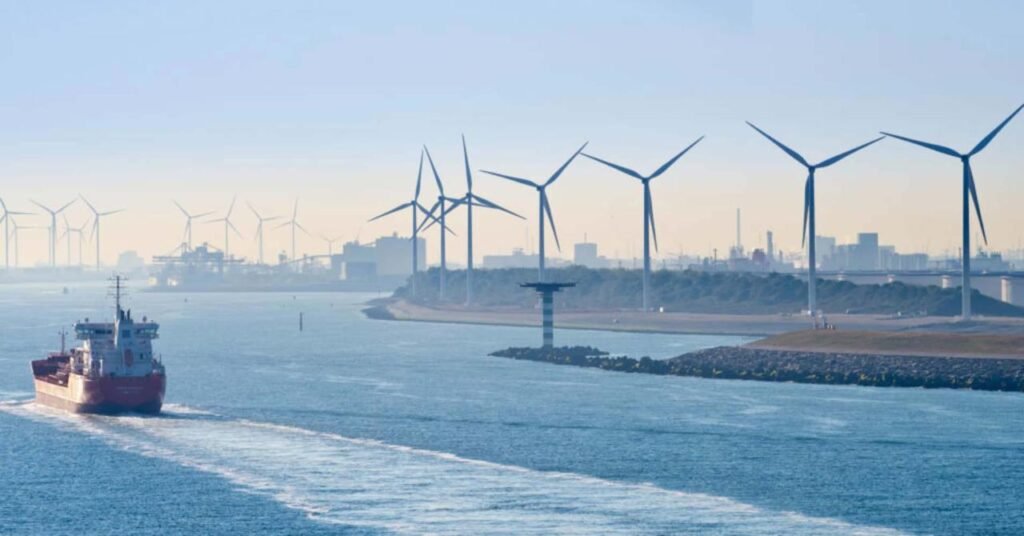
Side note, in the CNBC provided image for this article, note the placement of hordes of wind turbines juxtaposed with a single ship.
Apparently wind turbines can “fix” shipping emissions.
===========================
“A sweeping regulatory change in 2020 to slash air pollution from the world’s ships could have played a role in boosting global average temperatures, according to the findings of a controversial study.
Described at the time as the “biggest change in oil market history,” the International Maritime Organization (IMO) enforced new standards on Jan. 1, 2020, to cut their fuel sulfur content to 0.5%, down from 3.5%.
The rule change resulted in an 80% reduction in sulfur dioxide emissions, a team of scientists said in a paper published by the Communications Earth & Environment journal on May 30, and may help to explain why last year’s record-breaking heat was so extreme.
Tianle Yuan, a research scientist at the University of Maryland and the study’s lead author, said via social media that the impact of the clean air regulations could be described as “an inadvertent geoengineering event.”
That’s because the sulfur dioxide, a pollutant which forms when sulfur-containing fuel such as coal or petroleum oil is burned, reacts with water vapor to produce aerosols that reflect sunlight back into space.
The aerosols have a direct cooling effect, though climate scientists note that their contribution to global cooling or warming when they are reduced remains a complex area of research.
The study said the abrupt fall in sulfur emissions since 2020 supports the viability of marine cloud brightening, a growing area of scientific interest which some researchers say could be used to help cool the planet.
… “There are three interesting things that people are trying to pin down as to why 2023 was so alarmingly warm and the first one that everyone’s heard about is El Nino,” Jim Haywood, professor of atmospheric science at the U.K.’s University of Exeter, told CNBC via telephone.
“The second one is that people are not quite so aware of is Hunga Tonga, which was explosive volcanic eruption that was very unusual.
● And the third one is IMO shipping regulations,” Haywood said. …”